
You’ve got a client asking about a year-end estimate, two people waiting on engagement letters, and a calendar that made more sense when you looked at it yesterday. Then your cyber insurer emails to say your website is “likely vulnerable” and requires “immediate action.”
What are you supposed to do with that at nine in the morning?
That’s the language in a real alert a tax firm received this week. The email concerned a security issue in nginx, software that helps serve websites and web applications. We’ve already had customers ask the practical question that comes next. When are you going to fix it?
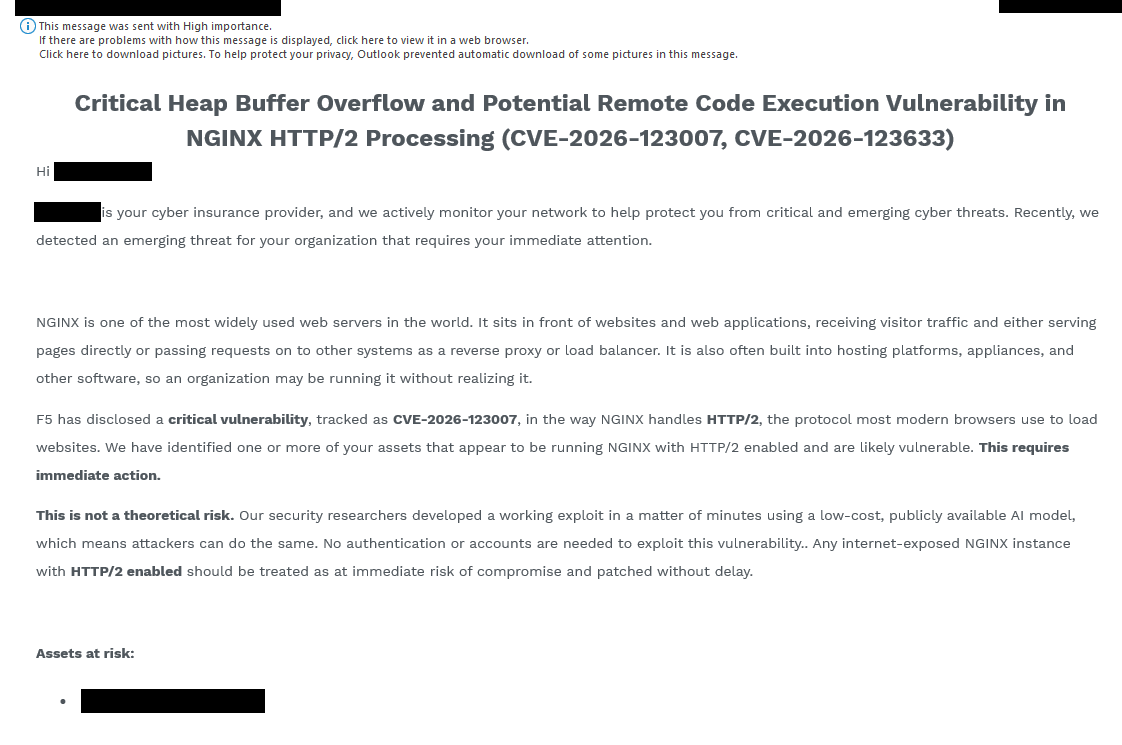
An anonymized cyber insurance alert sent to a tax firm in November 2026.
Your website can look fine while an alert is still open
Last week, the Associated Press covered a widespread Microsoft outage that left people struggling to get into Outlook and use other services. When email stops working, you feel it immediately. A website security issue can be harder to make sense of. You open your homepage, it loads, and everything looks the way it did yesterday. The insurer is still waiting for an answer. Associated Press coverage of the November 12 outage
I’d pay close attention to the word “likely” in that letter. Take the alert seriously and ask your provider to check the exact domain or IP address the insurer flagged. A scan from the outside can give the insurer a reason to reach out. Your provider can check what’s actually running, whether the finding applies to that setup, and whether the relevant fix is already in place. Sometimes a scan even associates a domain or IP address with the wrong organization. Insurer guidance on scan findings and rescans
Then, on November 19, PHP released a separate round of security updates for versions 8.2 through 8.5 that address vulnerabilities rated critical. PHP runs underneath WordPress and many other websites and applications. If you ask whether your site is up to date and the answer is, “Yes, we updated the WordPress plugins,” there’s still a question to ask about PHP. It has its own updates. Official PHP release announcements · PHP security advisories
Who do you call when the email comes in?
Maybe the person who built your website still helps with edits. Maybe another company hosts it and your IT provider handles everything inside the office. All three may do good work. It’s entirely possible that each assumes someone else is responsible for the software behind the website.
If you’re in that position, start by forwarding the alert to whoever manages your hosting. Include the address the insurer flagged, the vulnerability ID if the email lists one, and any deadline. Here’s what I’d send:
Our cyber insurer flagged [domain or IP address] for [vulnerability ID or finding]. Can you check whether this applies to the live service?
If the fix is already in place, please tell us what was updated and when you verified it. If it’s still open, please tell us who’s handling it and when we can expect an update. If the finding doesn’t apply, please explain why so we can send your response to our insurer.
That gives your provider something specific to check and gives you an answer you can forward. If the alert is vague, ask your insurer for the exact address, the scan date, and what it found. If your provider verifies the fix and the alert is still open, ask for a rescan.
What we did at CountingWorks PRO
Our DevOps team monitors security releases as part of running the infrastructure we manage. We applied the nginx security update on November 18. We were already tracking the PHP release, and our team began applying that update after it became available on the morning of November 19. Customers on the infrastructure we manage don’t need to install either update themselves.
The part I care about as a business owner is what happens before that email ever reaches your inbox. Somebody should already be watching for the release, checking where it applies, and getting the update onto the systems they’re responsible for. You’ve got enough to do getting clients ready for year-end. Working out who patches your website shouldn’t become a project every time your insurer sends an email.
If you can’t name the person or team responsible for updating your website, ask now, while there’s time to get a straight answer. And if you’d rather have that work handled for you, talk with us about a managed website for your tax or accounting firm.
For more on the October PHP vulnerabilities and why website maintenance deserves a place in your firm’s security plan, read The PHP Security Wake-Up Call.