

How much time does your tax and accounting firm spend chasing documents, following up with prospects, sending deadline reminders, and checking whether work has been completed?
Now multiply that across every employee, every day, all year long.
The opportunity for AI isn't simply to make those tasks faster. It's to stop requiring your team to initiate them manually in the first place.
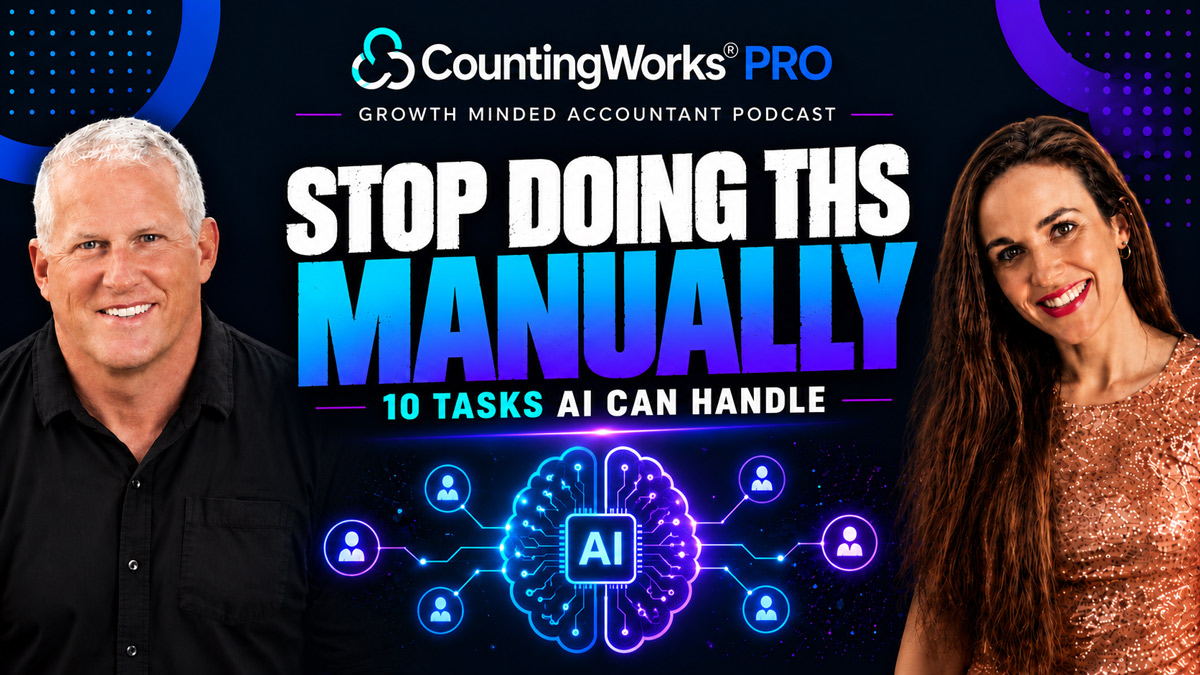
In this episode of The Growth Minded Accountant, Lee Reams, CEO of CountingWorks, and Rebekah Barton, Chief Visibility Officer at CountingWorks PRO, explore 10 activities tax and accounting firms should be able to automate—and why AI agents are changing the way practices operate.
From personalized prospect follow-ups and client onboarding to identifying advisory opportunities hidden inside your existing client base, Lee and Rebekah explain how intelligent automation can help firms become more proactive, responsive, and profitable.
They also introduce a fundamental shift in practice management:
Stop telling your software how to do something. Start telling it what you want to accomplish.
Imagine asking your system to:
Instead of configuring every step, your technology increasingly understands the outcome, uses relevant context, and helps carry out the work.
And importantly, AI doesn't replace professional judgment. It gives tax and accounting professionals more time to apply it where it matters.
Your next competitive advantage isn't another dashboard or another software subscription.
It's technology that understands your clients, recognizes opportunities, and helps your firm accomplish more without adding more manual work.
With MAX Automations and MAX Practice Intelligence, CountingWorks PRO is helping tax and accounting firms move beyond managing tasks toward intelligent, outcome-driven practice management.
Start with one outcome. Build from there.
Every new inquiry represents an opportunity. But during tax season, responding quickly can be difficult when everyone is already busy.
An intelligent system can recognize what a prospect is asking about, identify the services that may fit their needs, and prepare an appropriate response.
Someone looking for business tax preparation shouldn't receive the same message as an individual seeking help with a personal return.
AI can help personalize that communication, recommend a consultation, and manage appropriate follow-ups when someone doesn't respond.
The goal isn't more automated emails. It's making sure qualified prospects don't fall through the cracks.
Traditional onboarding often depends on static checklists and staff members remembering to initiate each step.
But onboarding a new S corporation client is different from onboarding a nonprofit, restaurant owner, or individual taxpayer.
Imagine telling your system:
"When we onboard a new S corporation client, request their prior returns, ownership information, financial statements, and everything on our approved onboarding checklist."
An intelligent system can help create the appropriate requests, track progress, and follow up on outstanding items.
That produces a more consistent process for the firm and a more personalized experience for the client.
Few activities consume more unnecessary time during tax season than requesting documents clients haven't provided.
Traditional reminders are often generic. Sometimes they even request something the client has already uploaded.
A context-aware system can review the current status of each client's document collection, identify what's actually missing, and send a relevant reminder.
For example:
"Every Tuesday, review my active individual tax clients and remind anyone with outstanding requested documents."
The system should understand the difference between a missing W-2, an outstanding K-1, and an item that's already been received.
The benefit isn't just administrative efficiency. It's fewer frustrating communications and a smoother experience for clients.
Not every client has the same filing requirements.
A nonprofit organization, S corporation, partnership, and individual taxpayer can have very different deadlines and obligations.
Instead of manually segmenting client lists and scheduling separate campaigns, imagine telling your system:
"Identify my nonprofit clients with upcoming filing deadlines and send the appropriate reminders."
A more intelligent process can use client type, known filing status, and relevant deadlines to determine who should receive which communication.
This is the difference between sending a mass email and delivering timely, relevant information.
Deadline automation should also account for extensions, exceptions, and professional review when needed.
Most firms invest significant time and money attracting new prospects.
But what happens to people who contacted the firm six months ago, never scheduled an appointment, or decided to wait?
Often, nothing.
AI can help identify dormant prospects, review their previous interests, and suggest an appropriate reason to reconnect.
It can also support thoughtful outreach to former clients when circumstances create a relevant opportunity.
Instead of asking your team to remember who needs follow-up, the system helps surface conversations worth restarting.
Your next new client may already be in your database.
This may be one of the most valuable applications of intelligent automation.
Your existing client base contains information that can reveal needs beyond annual tax preparation.
Some individual tax clients may benefit from more proactive planning. Certain business owners may need cash flow support, entity planning, or recurring advisory conversations.
Traditionally, identifying these opportunities depends on someone reviewing the records and recognizing the potential.
Imagine asking:
"Every Monday, review my individual tax clients and identify five potential tax planning or soft advisory opportunities for me to evaluate."
AI can help analyze available information, recognize patterns, and present opportunities with supporting context.
The accountant still determines whether the recommendation makes sense.
The difference is that potential opportunities become visible before someone remembers to look for them.
A list of potential advisory clients has limited value if nobody follows up.
Intelligent automation can help bridge the gap between identifying an opportunity and actually starting a conversation.
Once an accountant reviews and approves a recommendation, the system can assist with drafting a personalized message, creating a follow-up task, or initiating an approved workflow.
Think of the process as:
Identify → Explain → Review → Act → Track
The professional controls the decision. The system helps carry out the next steps.
That distinction matters because the goal isn't simply to generate more insights.
It's to create more meaningful client relationships and opportunities for the firm.
Online reviews can influence how prospective clients discover and evaluate an accounting firm.
They also provide information that AI-assisted discovery tools may encounter when researching potential service providers.
But many firms ask for reviews inconsistently, if at all.
An automated process can identify appropriate moments to invite honest feedback, such as following the successful completion of an engagement.
Rather than depending on someone to remember, the request becomes part of an established client experience.
Over time, a steady process can help build a more substantial body of authentic client feedback.
The important principle is to request genuine reviews, not manufacture ratings or dictate what clients should say.
A restaurant owner, real estate investor, medical professional, and retiree shouldn't necessarily receive identical marketing communications.
Their concerns are different. Their tax planning opportunities are different. Their reasons for contacting an accountant are different.
Yet many accounting firms still send the same content to everyone.
AI can make it easier to deliver relevant communications based on the services clients use, the industries they operate in, and their known needs.
The episode also explores MAX Concierge, which brings conversational AI into the firm's website experience.
Instead of reading a static article and leaving, a visitor exploring a subject such as a 1031 exchange can ask follow-up questions and potentially continue toward a consultation.
The opportunity is to turn generic marketing into more useful, personalized engagement.
Imagine opening your practice dashboard each morning and seeing a summary of what your technology accomplished.
New prospects received appropriate follow-ups.
Nonprofit filing reminders were delivered.
Clients uploaded missing documents.
Dormant prospects reengaged.
And your weekly analysis surfaced five potential advisory conversations.
Instead of starting the day wondering what needs to be done, you're reviewing what's already happened and deciding where your expertise is needed.
This is the idea behind a daily practice intelligence briefing.
The system helps organize activity, surface important developments, and direct attention toward decisions that matter.
For smaller firms especially, this creates an opportunity to operate with capabilities that traditionally required more administrative staff.
Automation isn't about removing accountants from the client relationship.
It's about removing unnecessary manual work so accountants can invest more time in professional judgment, meaningful advice, and personal relationships.
AI can identify a possible tax planning opportunity. A qualified professional decides whether it's appropriate.
AI can draft client communication. Your firm determines when review and approval are necessary.
AI can organize work, follow up, and surface exceptions. Your team remains accountable for the service being delivered.
The future isn't AI instead of accountants. It's accountants accomplishing more with AI.
And you don't have to transform your entire firm overnight.
Start with one problem. Choose one outcome. Then ask why someone on your team still has to perform that work manually.
We know that everyone digests information differently. That’s why we’re now sharing the full transcript of each episode of The Growth Minded Accountant right here on the CountingWorks PRO blog. Whether you’re short on time, like to scan and highlight, or simply prefer reading over listening, you can catch up on every conversation at your own pace.
Each week, we cover topics that matter most to tax and accounting professionals—from AI and automation to marketing strategies, firm growth, and client relationships. Scroll down to read the full episode, or subscribe to the podcast to listen on the go.
Welcome back to another episode of the Growth Minded Accountant. My name is Lee Reams. I am the founder and CEO of County Works and our sister company, TaxBuzz. Today's topic is something there's a lot of, we've been talking about AI agents.
There's a lot of, on social media, you can't get away from it and what AI agents can do. And we're going to expand on it. We'll give you some examples of what we're building inside Max and our County Works platform and give you some really good takeaways on things we call the topic here today, ten things your tax and accounting firm should never have to do manually again. And that sounds wonderful.
And it is true. And we're going to give you some really concrete examples and ways that you can integrate these tips or these agents into your own practice and then the background of why and how to do it. So as usual, I am joined by Rebekah Barton, our chief visibility officer, freshly back from Paris last week. Well, all of us County Works, we were working with all our clients just like you on the deadline.
No one wants to talk to Rebekah about rewriting the branding. So she disappeared to Paris with her family. But how did that go? It was good.
It was good. We avoided the worst of the riots. Thankfully, we started in Paris a couple of days before it got really bad. So we were out at Disneyland and moving on to London by the time things got crazy.
So my kids first transatlantic and they did great. So it was good. All right. Very good.
I was expecting some viral moment of you, but that's all right. Maybe it hasn't hit here yet. It may not have hit yet. I'm still posting.
All right. So I like setting up a story or thinking through how your firm actually runs. So let me ask you something. how many times did someone in your firm send an email yesterday that could probably have been sent automatically? Or perhaps overnight you guys came in and you had six client inquiries.
And, could you imagine if your software had automatically done all the research and drafted the response for your review to you? change and make it better and send. those are things that can be done here in the future on autopilot. So how many times did someone chase down a missing tax document? Follow up with a prospect, remind a client about a deadline. I'm sure, or you just don't do it.
You don't have enough time or your system can't accommodate that or check whether something has been completed. some tax tasks, checking the Canada board, whatever. Now multiply that by every employee in your firm. every day, all year long. And I think you'll realize that's an extraordinary amount of time. So we here at CounterWorks have spent years building technology to help tax professionals work more efficiently.
But I think we're entering a completely different era. And there's a phrase that I've developed as the theme for this podcast. And I think it really captures what this shift is. Stop telling your software how to do something. and start telling it what you want to accomplish.
So think about the difference. Traditionally, if I wanted to remind all my nonprofit clients about an upcoming filing deadline, I'd have to find those clients, go into the CRM. Hopefully you have them segmented or tagged. You would then need to verify the relevant deadlines.
So there'd be some research behind it. You would build this list. prepare a message, proof the message, make sure the grammar is all correct, and then, of course, schedule it. But now imagine being able to tell your software, hey, every month, review my nonprofit clients, identify their upcoming filing deadlines, and send the appropriate reminders on autopilot. And that's a very different relationship with technology.
So today, Rebekah and I will talk about, again, these ten things that tax accounting firms should know Shouldn't have to do manually anymore. And I think this is really important because Rebekah, AI agents and intelligent automation are doing what for professionals? Yeah, so I think people are hearing about AI agents, intelligent automation, AI in general, and they're still wondering what it really means for their practice in concrete terms. Agents in particular have been getting a lot of press lately with meta dropping news.
People are downloading that app for the first time, maybe starting to understand the difference between an agent and other AI systems like chat GPT. And they're still thinking, that all sounds really great, but I've got, one hundred and fifty clients I need to finish tax returns for. And I've got people who haven't sent me their documents and I've got prospects I need to call back. And a lot of this, if they're not using it, still seems theoretical and confusing.
Yeah, and I think what we're realizing as we're building out our own technology and Macs and our Macs automations here at CountingWorks is I'm a hundred percent convinced that it isn't really simply about doing the same work faster anymore. It's about getting more work done automatically. I like the word autopilot. But more importantly, I think it's about delivering a better client experience and creating growth opportunities that might otherwise never happen.
And let's get into the ten. Rebekah, we're going to start with something you love. And it's one area that I find the biggest flaw in a lot of tax and accounting systems, and that's following up with new leads. And now as more leads are coming through recommendations from tools like ChatGBT, not just referral sources, but either way, a referral calls you, a recommendation comes from ChatGBT, and then it just gets dropped.
So Rebekah, let's talk about how to use automation and autopilot to really personalize this experience. Like we said, prospects and leads are very important to me. With visibility, obviously, that's a big part of what we do. My department is trying to get eyes on people's websites and on their blog posts and on their social, on their brand online, basically.
Let's think about what happens during a typical tax season. So someone might visit your website looking for tax prep, business accounting, tax planning, any of the services that you offer. They fill out your contact form or perhaps they send you an email and then think about what happens next. At a lot of firms, that inquiry just lands in someone's inbox.
And if it's March or April, good luck getting a response off quickly. Everyone is swamped. Everyone is busy. but that prospect has probably contacted other firms if they're using ai for example the odds are good that they got a list of two or three firms that could meet their needs maybe it was you and one or two others so the moment someone submits an inquiry let's think about if it was different What if your system automatically recognized and read that email and started writing an appropriate response? So someone looking for business tax prep, for instance, would get information about that service and an invitation to schedule a consultation.
Someone who's interested in having their personal return prepared would get a different email tailored to those circumstances. And then if they don't answer, the system would follow up at appropriate intervals without your team having to literally lift a finger. That's the work that automation can do for you on a daily basis. Yeah, and I was sharing... with Patrick on our team and our onboard team, we had a client who was complaining they had too much traffic to their website.
They had too many prospects and they just don't have time to follow up with them. I'm like, well, why aren't they using our automation tool? But that's a different story. But I think what's drives me nuts is, we spent all this money trying to attract new clients. we create this new narrative.
We start finding the ideal clients or finding us. We build the website. We're publishing content to our restaurant clients. We're running these marketing campaigns.
We're working on getting more five-star reviews and referrals. And then someone actually raises their hand and says, I need help. And oh, we're too busy. And as Rebekah said, the communication does not have to be generic.
And that's the beauty of automation tools and AI tools like Max that can a hundred percent personalize this as they go. Leads, please follow up, create an agent, whether it be through Claude or ChatGPT or use a tool like Max that does this on autopilot. It is so easy to set up. It is so easy to run.
And I mean, you'll qualify people. By the time they're reaching out to you, they have had that personal engagement with you. They're more likely to convert to being a client. So it makes things a lot easier.
So the number two thing is client onboarding. And if you're on Instagram or anything, you're seeing all sorts of ads for what I call practice management tools that are adding some AI tech on top of their old onboarding. And what I'm getting into is I think the real goal is to do hyper personalization, not just take stock software that does a task. and make it just a little more efficient, right? I think the real needle moves when you're able to add a lot of personalization.
So think about everything that happens when someone becomes a new client. Hopefully you're sending an engagement letter, really, really important for scope creep, legal protection, really defining what the relationship's all about. You might need prior returns. If they're a current client, you have access to them, but is your technology reading them?
You might have an intake form, a questionnaire, tax organizers, maybe accounting records and access to the appropriate system. So someone has to coordinate all of this. And for many firms, that's still a manual process. But once a client signs an engagement agreement, why shouldn't it just trigger something else? the welcome communication goes out.
How do we work? What are the next steps? It makes it so that extra phone call bothering you following up is it doesn't happen, right? the right documents are requested. We have a new intake form that actually will determine what those are.
And then it even allows the client to add color. what? Hey, I sold my house this year, too. Oh. Okay, we're going to need more things.
It's intelligent enough to create what we call smart profiles. So think of it, internal activities are assigned, right? So what staff member is doing the analysis, who's reviewing it, who's pushing it through the process for review, right? So everyone knows what's outstanding.
And here's where specialization matters. A new Ten Forty client should have one onboarding experience. An S corp client should have another, right? I mean, they obviously have different needs.
They have different backgrounds. They have different liability issues, right? A monthly bookkeeping client might need something completely different. So Rebekah, this is where I get into the hyper personalization and where you're going beyond what a traditional practice management system can do.
Right. So onboarding is going to be your clients, a new client's first real impression of your firm. They've probably gotten an impression of how you're supposed to operate from your website, from your social media, from your online presence. But once they actually start working with you and start going through the onboarding process, that's when they see basically if you're if you're walking the talk, right, or all the things you say about yourself online and on your website, is that actually the experience that plays out for them?
So it also reinforces your current client's impression of you as well. Absolutely. Are they still on their game? Are they using tech?
Am I getting the best client experience? Are they responsive? Right. So every year you got to prove yourself.
And we're in recurring businesses, so it's really important. So imagine telling your system, hey, whenever we onboard a new S corp client, request their prior returns. ownership information financial statements and anything else on our approved onboarding checklist okay and then keep the system that keeps moving so if there's missing something have some reminders right automatically follow up right and that's not just staff efficiency that's a better client experience and that is a hundred percent happening right now with agents being able to create that workflow to create that personalization to have a lot of this run on onboard we even have the option so we let people choose do you want them to say hey here's your intake process and when they log into their client hub or their portal It automatically takes them through three or four questions or screens that almost personalizes the intake experience on the fly. I think it even determines these are the documents that you should be sharing with us and then gives the to-do list for them. And then it sets up the automation to chase it.
So which gives me into our third one is chasing missing tax documents. This might be, I consider, one of the most popular ones or the biggest hassle or the biggest pain. How many hours does your firm every tax season spend asking clients for information they should have already sent? But more important, you got to think of it from a client's point of view, too.
They're busy. Taxes are not their favorite topic. That's not their favorite thing to do each year. And they just may or you may have interviewed them.
Let's say you did an interview in March, but they own they have a bunch of K-ones, so they don't file till, later in the year in the fall. They forget, did I share my W-tutes with you? Did I get another ten ninety nine? And a smart system should be able to follow where they are, where the taxpayer is and determine what is still missing and more importantly, prompt them To, hey, by the way, we're still missing a couple of K-ones.
So imagine telling your system something like this. Every Tuesday, review my active individual tax clients, identify which requested documents are still missing, and remind those clients what we need. Now, see the difference again where... I am now working with my software versus my software is this is what it does.
This is all I can do. Now I'm able to hyper personalize the outcomes what we started with with this topic. And Rebekah, why is that so much better than the old days? It's very important because we've all received an automated reminder about something we've already done, right?
Whether it's something you were supposed to submit or a step you were supposed to take, something you needed to upload, and it just went out automatically and it didn't actually recognize the fact that you had already sent that particular piece of information into the system. That can be really frustrating. And on top of that, it makes you feel like the business doesn't know what's going on. Right.
Like I know when that's happened to me, I'm like, are you actually paying attention? Because I already said that. And so it you start to have diminished confidence in the service provider. And when it comes to tax and accounting, obviously, confidence and trust are important.
So important because you're dealing with people's finances. So I think what this does by automating all of this, you're really taking that out of the equation. There's no longer going to be these mistakes where people are being told, hey, you didn't do something or you need to do this thing that you've actually already provided. Right.
And that's the difference between automation and intelligent automation. So that example, when someone's missing the document, they upload it and then the reminders continue. Maybe the system wasn't smart enough to know, OK, I have eight out of the eleven documents. I'm only chasing these three now.
Right. And that's a big difference. So if your systems aren't completely connected, all you've done is automate a bad process if they're not communicating. Oh, I have this now that the due date reminders here, the missing information communication goes here.
Those are the things that I think create a little bit of a bad user experience. So if something requires a human conversation, your technology should also bring the appropriate person into the process. So a workflow needs to know exactly what's happening. So think about during tax season, your staff spends more time preparing returns and less time chasing paperwork.
And that is why an agent like this chasing documents is so beneficial, time savings, whatever. We talked about this a little bit, but we're going to go into tax deadline reminders. There was an old way we used to do postcards. We used to print tens of hundreds of thousands of postcards and our clients would mail them out.
And it was a really good service or value add to a tax relationship. But now with AI and technology stacks, This is amazing what you could do. And the big thing here is not every client is the same. We gave that, illustrated that, but Rebekah, jump in here a little bit.
Yeah, so I think this is where we can really demonstrate the difference between those traditional automations and what intelligent systems now make possible with AI. So sending a reminder isn't necessarily a complicated task, right? You could theoretically do that manually, not have it take too much time. However, knowing who needs which reminder is where the bottleneck often happens.
Because not every client needs the same reminder. Not every client files at the same time. Some people might have extensions, like you noted, Lee. Some people don't file until the fall.
There are different business and personal deadlines that people need to meet. And keeping track of all of that with a manual process is tedious at best, impossible at worst. Well, no one does it. So what technology now is allows us to do it at scale.
We gave the example of a nonprofit earlier, every month review my nonprofit clients and identify their upcoming filing deadlines, send the appropriate reminders. you now need to consider what's involved. The system needs to know which clients are nonprofits. their filing requirements, their fiscal years and which deadlines actually apply. So think of it this way as a different version is review my S-corp clients and make sure they're receiving the appropriate business filing reminders. Also identify owners who may need personal estimated tax reminders. right so those are two completely different client populations with different obligations and now i am able with technology to personalize that experience and i could do something different with my individual clients so instead of sending one blanket email everyone says there's a tax deadline approaching You're actually communicating based on each client circumstance.
So that is what I love about technology and automation tools like we've built with Max. I'm not manually building five different lists and five different campaigns. I'm actually describing the outcome, what I want to accomplish, right? What I said in the beginning.
So obviously the firm needs accurate client information. This is the big deal, Rebekah and client segmenting. We have the ability to append information about clients. Not enough people use this.
And what I mean is the more context you have about a client, the more personalized technology can deliver. And why is that so important when it comes to the client experience side of that tight relationship? And again, I think it gives better financial outcomes, better experience. Absolutely.
People love personalization. And in today's world, they're becoming very used to personalization, right? Almost everything you do is customized to you. So in this case, instead of sending one mass email to everyone saying, hey, first name, a tax deadline is approaching.
You're communicating based on that client's actual circumstances, their actual needs. You're reminding them of exactly what they need to provide, exactly when they need to provide it. And that's going to be different for every single person. So the ability to do that is dramatically improving your client experience, probably compared to most other people who you're competing with in your area, right?
Not everyone is using this, like we said, not enough people are using it. So this is a really simple way to elevate everything as far as your client experience goes and making people feel like, you really care about them and their exact situations. Yeah, and I think as technology continues to get more powerful, you're going to see people expecting this type of hyper personalization. An interesting, just totally off industry, but if you're watching Netflix and their stock price crashing, and again, I'm not predicting where it will go, And then they're blowing out their content team. they're changing strategies, what's working, what's not working.
But if you look at the future of entertainment is people are going to be able to create their own entertainment, right? And more and more people have control of their own entertainment. whether that be from a creative side or the the opportunities to see what i'll call content from all sorts of sources it takes the monopoly power out of netflix because they can't hyper personalize that entertainment experience anymore maybe they have a grand plan on how they're going to pivot but over time tools like claude and chat gbt are being able to and new startups and new entertainment starters are going to be able to hyper personalize everything. And what I'm getting at is that same experience should be expected from your firm as well. And why not?
The technology is there. So let's go to one that really moves the needle in an ROI, a revenue standpoint, and that's reactivating dormant prospects or perhaps winning back former clients. So Becca, let's jump into this. Why is it so important and what are some strategies to do this and how you can create an automation?
Again, we call them automations at Max. You can call it an AI agent, whatever you want, but explain a strategy and how you would reactivate dormant prospects or perhaps win back former clients. Absolutely. So this is number five, just for those following along numerically.
And this is something we've talked about on the Growth Minded Accountant previously. So that's the value of your existing database and your existing client base. So think about all of the prospects who have contacted your firm over the years. Maybe someone reached out during tax season, but they never scheduled.
Maybe a business owner thought they wanted tax planning, but then they weren't ready to move forward at that time. Maybe someone requested a proposal and then ghosted you and you never heard back from them. So what happens to those people, right? They exist.
They're out there. You have their information. And at a lot of firms, the answer, unfortunately, is nothing. They just sit there in a spreadsheet or in a CRM, and they just flounder for months or years.
But imagine if you could tell your system every week, identify prospects who contacted us in the past year but never became clients. Group them by what they were interested in and send an appropriate follow-up. So a prospective tax client, for instance, might receive an invitation to schedule before the end of the year. Someone who contacted the firm during the last filing season and then disappeared might receive a timely message before the next filing season.
So those are the types of things that your system could now do for you without someone having to go through and manually segment all of this, which, like you alluded to earlier, Lee, no one is really doing right, even though it could theoretically be done. So this is a way to get that task off your plate and hopefully see a really great return. We get shocked when we bring in a new client who has segments at all. So yeah, I don't think taxed accounting firms took those marketing classes and understand the importance of it.
The beauty of it is technology has trumped it all and now can deliver this on scale. And it doesn't feel like a mass marketing campaign. It can be highly personalized to each client. So I think it's really important in another way.
And think about it again, not just your prospects, but people that may have left you for whatever reason. Maybe they moved. Maybe they thought you were too busy at one point and they're unhappy with the choice they made wherever they went. And suddenly you appear in their inbox.
It gives us like an invitation to re-engage you. You'd be shocked how well Winback campaigns missed you last year. We used to call them missed you last year campaigns. And we just, again, in the print space in the old days, we had missed you last year cards.
Again, hyper effective. And those are the old days of postage and sending a note, but they work very well. So this is just another way to use automation to help build your business. The next one, number six, identify tax planning and advisory opportunities.
This is the biggest ROI. And I think this is the biggest, I guess, powerful tool that we're developing for clients. And it's not just, everyone thinks advisory is these high-end monthly advisory packages. And some people will say, well, my clients don't have any money.
Well, the first question I would say is attract clients that do, but that's a That's a Rebekah discussion you have. But if you don't, you definitely have soft advisory opportunities, and those exist around life events. Think about it now, a client calls with a question, you answer it, they need a return prepared, You prepare it. I know it sounds like compliance, right?
Because it is, right? They ask about a deduction. You explain it. But what about the opportunities they don't know how to ask about, right?
What about the tax planning conversations that never happened because we're all too busy? You're just doing the return, right? And I'll give you an example of how to use an automation or an agent to effectively find or source these soft advisory opportunities. So every Monday morning, analyze my business clients and identify five who might benefit from an advisory conversation.
Tell me why. So prep, why do you think they're a good candidate? And prepare personalized outreach for my review. It even could create a proposal for those clients.
And think about that. Maybe a client's revenue has increased significantly. Maybe they had a bunch of new hires, right? Because you see that data in their documents, right?
Maybe a business has expanded into another state. Maybe a client could benefit from better cash flow management. You're seeing seasonality, whatever. But the AI is able to look at all the data, look at all the documents and conversations you have and identify those situations that bring it to your attention.
So the old days, if you try to do this manually, what did you do, Rebekah? You go into your hub and look at all their documents and try to figure out what these opportunities are. Yeah, it's impossible, right? That's just something no one was doing.
It's a total theoretical. So because no one was doing that, this is basically just a completely new opportunity. It's an area where you can really increase revenue and help more people that you really weren't doing before, or the odds are extremely good that you weren't doing it before. This is not something that most people were doing.
It's a really great way to open up this whole new revenue stream while also helping your clients and increasing their trust and your abilities to assist them with their financial lives. Well, yeah, let's just think about the financial outcomes you're going to help create, saving tens of thousands of dollars in liability, perhaps identifying something in a growth opportunity for a business. I mean, I think it's game changing. And, I say at minimum, fifty to one hundred thousand dollars a year is sitting in soft advisory opportunities inside your existing client database.
All these life events are happening. If you're more just reactive versus predictive, you're missing out on these opportunities. Think about it this way. Review my ten forty clients that identify people who may benefit from retirement planning, capital gains planning or a year end tax projection.
OK, so now your system is looking across the individual tax client base. If you've tagged it, if not, smart systems can figure out these are ten forty clients. Right. So maybe someone's income has changed significantly. maybe someone is approaching retirement age so maybe social security planning is a soft advisory okay maybe a client has investment activities that deserve a closer look and most likely you're so busy you would never get around to reviewing all those returns proactively it just doesn't happen but a platform like max can help surface situations worth examining assuming It has the appropriate authorization information.
And I want to make sure you understand there's a lot of new rules and nuances about what you're allowed to share with different systems. We actually just created a new system that strips out all personal identifiable information from anything that is shared with a tool like Gemini or ChatGPT or Claude, you won't know or the system won't know. Right now, if you're doing that in Claude and you're giving them your tax return, their tax return, you got social security numbers, they got their home address, home phone. Their birthday is everything.
I mean, so you've got to be really, really important that you, as a professional, are working with a tool that knows the guidelines and where you can or cannot do things. So I'll give one more example of this. I think this is really important. I want takeaways that you can think about.
Every Friday, review my restaurant clients and identify businesses that might benefit from cash flow or profitability advisory services. Again, you could have one for dentists. You could have one for real estate investors or contractors. You could have different recurring intelligence working for every single niche.
All you need to do is tell a tool like Max, this is what I want you to look for. It will automate the process. We have a dashboard and you can see, okay, here's your seven advisory opportunities. Review them, human in the loop. oh these are good now the ai doesn't know what they're talking about this is they're missing this information delete or yeah let's continue the conversation let's send some outbound messaging right so what we're talking about here is helping professionals identify more ways to serve their existing clients and i think that is where the real opportunity is so even if you do not want to get any more clients you can now change the way your role, perhaps you could even work with fewer clients and make more money.
So really important. So the next one, number seven, turning opportunities into action. So this builds directly on what I just talked about, because identifying the opportunity is one thing. Actually doing something about it is another, right?
So let's say your system identifies the five clients who might benefit from tax planning. Great, now what? I got more work, right? And I've been talking about this.
We did a podcast, how the partner is your bottleneck. And this is very true. This might be the same thing where whatever the partner, the firm, whoever's making these decisions, you become the bottleneck. So you create a spreadsheet, you add a note or you tell a partner and then the tax season gets busy and absolutely nothing happens.
So the opportunity disappears and imagine, the weekly instruction goes further now so identify five clients who might benefit from tax planning explain why so i know why you think they should have tax planning right what is the research behind it what is the code and prepare a personalized email inviting each of them to schedule a consultation Rebekah That sounds pretty exciting. When I come into the office Monday morning, I now have five potential revenue opportunities and the draft communications are ready for my approval. I can review them, make any changes and authorize the outreach. But once someone responds, the next appropriate step can be triggered.
Yes. Yes. So it is. It's really exciting.
So that means, then number six is about recognizing opportunities. And number seven is about making sure that something actually happens and action takes place. So this is this is great. This is game changing for almost all firms, because like you said, Lee, this is something that wasn't previously happening.
And now it can and it can literally happen at the touch of a button. Yeah, we've been building dashboards, reports that tell accountants what's happening, but information alone doesn't grow your practice, right? And that's why I'm saying this is like the automation and the action actually does. So, this is what I mean when I say we need to change how we think about software and all these legacy platforms.
That's what they do. There's software that is limited. So stop telling your software how to do something. Start telling it what you want to accomplish.
So instead of asking, how do I build an automation that identifies certain clients, puts them into a list, creates tasks and schedules emails? I want to say, hey, help me create five new advisory conversations every week. Right. You see the difference? and the system helps figure out the steps right with the rules and permissions you've established so i think that's the direction we're moving obviously with max and counting works i want to share that you guys understand these are the capabilities that these tech stacks enable for you and i think it's going to fundamentally change how firms operate in the future Number eight, Rebekah, I'm going to let you run with this.
Requesting client reviews. It is so important in both for referrals, your online reputation, but more importantly, for tools like ChatGPT to recommend you. They need to see real clients having real good experiences, but explain how an agent or an automation could work in reviews. Yeah, the importance of reviews cannot be overstated.
They are critical. They've always been important. I would say they're even more important now in a lot of ways because these AI systems are really looking to reviews to understand, hey, do people actually trust you? Can you really do what you claim?
Are you providing outcomes that align with the other content that you're putting out there on the internet? just a little bit of background there and so we know that reviews are are valuable and important but how many firms have a consistent process for requesting them the answer there is remarkably few so maybe somebody finishes a return the client's appreciative and If you're lucky, one of your staff members says, oh, we should ask them for a review. And then nobody does. And it's just crickets. And you still have the same four reviews that you've had for the last five years, right?
But imagine if you could tell your software and you can tell your software, when we complete a tax engagement, send the client a friendly request for an honest review at the appropriate time. And I would argue that you should go one step further and tell it to ask them an open-ended question. asking how you solved X problem for them based on the service that was completed, right? These systems are smart enough to do that, and that's going to dramatically increase the quality of your reviews. Furthermore, no one falls through the cracks this way.
Automating review requests is a really great way to make sure that this relatively simple task actually gets completed and you start getting those five star reviews rolling in on a consistent basis, which is going to do wonders for your authority, wonders for your recommendations and AI systems. It's really a no brainer to do this one. I think this is probably one of the simplest yet most effective tips that we've given in this entire podcast so far. Come on, there's been a lot of good tips.
I said one-off, one-off. Just because repeats matter so much. All right. And a hundred percent is game changer.
We see it all the time with our clients when we're asking, we do audits of them and see how they're being recommended on ChatGBT and how many times it has their tax budget reviews right there. Well, on TaxBuzz, they have twelve clients who said this, this and that, or they had three restaurant clients and this is what they had to say. So it one hundred percent moves the needle. So that brings us into number nine, personalized tax accounting, tax and accounting marketing.
So explain, Rebekah, what this is all about. We're going a step further. We call it Max Concierge now, and we're actually bringing our AI technologies, our max intelligence to our clients websites. to their blog articles, to their pricing page. So on a blog, it might be about ten thirty one exchanges and it's a blog.
It's static. There's no one really I can converse with. The old day is contact us. Who's really hitting contact us?
The conversation ends. Imagine now Max Concierge sitting inside that blog article and say, hey, ask me about this. Ask me about that. Am I right for this?
Do I qualify for this? And now having a trained tax expert Sitting on your website now being able to evolve a conversation and move it forward to ask additional questions and then lead it into a discussion or an appointment or an actual client. So that's what we're doing with Max Consumers. But let's talk about personalized marketing approach and how it works with a tool like Max and what is best practices here.
Yeah, I'll back it up a little bit and just talk generically about why this is so important. So most accounting firms, I would say most, are still really approaching marketing by sending the same information to everybody. I talk to a lot of clients and I would say ninety percent of them. are not doing any personalized marketing. Very few of them are even doing segmented marketing when they come to us.
So that's something that we have to start with and just as simple as separating business from personal, right? And not even going any deeper than that. So let's think for a minute about the different people a firm might serve, a single firm. They might serve restaurant owners, medical professionals, real estate investors, retirees, small business owners.
All of those people have different interests, different needs. So a restaurant owner might be interested, for example, in payroll and cash flow. A real estate investor is probably going to care about things like depreciation, property transactions. Someone who's approaching retirement age likely going to be focused on distributions, tax planning for the future to get the most out of their golden years.
So let's think about telling your system every month, send my real estate clients relevant tax and financial updates and keep my restaurant clients informed about topics that could affect their businesses. This is where you start to provide value to your clients. You're top of mind because you're top of their inbox, but you're also providing them with actual actionable tips that are going to help them run their businesses better or help them make better decisions in their financial lives. And we've talked a lot about business.
I know we brought retirees in here, but you can do the same thing for personal. You can send out emails to people whose kids are approaching college age, people who have just had new babies. How is that going to affect your financial lives? People who have just purchased houses, people who have just gotten married.
There are so many different ways that you can segment and personalize your marketing. And it's really endless, honestly. And with systems like this that can pull people's information, you can really create some wildly niche tailored pieces of communication that could have a really serious impact on these people's lives. And in turn, have them approach you about, engagements and advisory services and things like that, that they probably never would have thought of.
You mean Gen Z doesn't want to hear about Social Security planning? I mean, I'm going to take a shot in the dark. They probably don't. Well, they should.
They should. But the point here is not to flood people with more content. It's less noise. It's more relevance.
And I think with tax-related content, you're going to see a huge uplift in the readership, the opens. Your clients, again, are going to feel more of a personal experience. And I think it helps build more intelligence for you to serve the client better. Which leads me to number ten, our last one here.
This is something that we've been working on inside Max and County Works, and it's your daily practice intelligence briefing. I think it's my favorite because it's almost like having an assistant working for you twenty four seven and really telling you exactly what's going on in your practice, exactly what your to do list is, where you have problems, where you have opportunities. So, imagine, writing at your office after a long weekend Monday morning instead of opening your email and trying to figure out what's happening. you open up your practice management system and here's what you see you see now twelve new prospects that contacted your firm over the weekend if you're if you have branding and you're attracting the right clients right nine received appropriate responses and three have already scheduled consultations You're like, oh, my God, this is great. This is marketing on autopilot, right?
Your nonprofit filing reminders went out to the appropriate clients. Your document collection workflows are running and several clients uploaded missing information. More importantly, three dormant prospects have reengaged with your firm. And your weekly client analysis identified five potential soft advisory conversations for you to review.
Think about that. You didn't have to manually initiate any of those activities. Right. A lot of the routine work has already happened.
And the research behind it, knowing what the tax code is and having a system that understands how your firm works. Right. What is happening now is your system is showing what needs attention. And I think this is really important for a smaller firm.
Thank you. where the owner is doing everything. You're wearing multiple hats, you're preparing the returns, you're meeting the clients, you're doing the Zoom calls, you're answering emails, and then you're trying to grow the business at the same time. And I think a lot of smaller firms have the most to gain here. And I also think this opens up boutique firms to be able to compete with the big fish, right?
They don't have the luxury, you as a small firm, of hiring a different employee for every function, but that's where you can outsource a lot of this functionality. That's the whole idea here. So, for years we built software that stores information in a database. Right.
And then we built systems that connect that information. But I think what we're doing now is we're not think we're entering an era where technology can help interpret this information, identify opportunities and more importantly, carry out these workflows. And the difference is that you can increasingly describe what you want to accomplish rather than manually configuring every step. So I'm pushing right back to all of the legacy practice management software.
There is a new way of doing things. It's skipping categories. It's a new category if you want to think about it. And it's not a matter of now managing more technology, trying to use Zapier and trying to connect a bunch of systems with AI that can talk to each other.
You can consolidate all this intelligence into one dashboard, not with a hundred charts and all these different buttons and training that takes thirty days for each group, each system. exactly what I'm talking about. So if you can actually talk to your system, talk to your technology, and it actually does that outcome, I think you're in a much better place. So those are our ten Easy ones. We could go on.
This could be four hours. I would lose my voice is almost gone. We would lose my voice for sure. But, we need to talk about something that's really important is the human in the loop.
So, Rebekah, jump in here and talk about, AI is doing all this stuff. But wait a second. we are we develop human and first technology. So explain this a little bit, if you could. Yeah, so I think there is a natural inclination here for tax and accounting professionals to worry, right?
Because when we talk about AI taking on more work automatically, people naturally wonder what happens to the human side of this profession. And the human side isn't going away. The point here is not ever to eliminate the tax professional. It's to make the professional more effective.
So if you think about all these examples that we went over today, all ten of them, do you really need an accountant spending time sending routine reminders or checking whether an engagement letter has been signed? Those are not where you are best utilized as an expert in your field. You're best utilized by deciding what tax planning strategy is right for someone, helping a business owner make an important financial decision, explaining a complicated tax situation to a family, or building trust and relationships with clients that could translate to years and years of serving their family, right? That's where your expertise is best utilized.
So allow these systems to do the tedious work, allow them to take the gobbledygook off of your plate and do the things that you just don't need to be doing, right? You don't need to be sending five hundred reminders about a tax deadline. So I think there are places where professional expertise really, really matters. But sending basic rudimentary emails is not necessarily one of them. yes and that's what i want everyone to the great takeaway here we spend so much time talking about ai reducing costs but how many hours can we save how many admin tasks can we eliminate those are real benefits those are things that are happening but what if you could respond to more prospects What if you could serve more clients without adding the same amount of admin overhead for that professional who's complaining they're getting too much traffic, too many leads, right?
Well, why don't you let the systems handle it? And then you just take the ideal clients that you want to add to your practice, right? What if you could have five additional advisory conversations every week? This is additional revenue on top of what you already have, right?
That's a new vacation. That's a new car. know it's your bonus it's a college education so what if your clients receive more proactive service versus reactive compliance work because your firm had technology helping identify these opportunities so now you're not just saving money you're creating the potential to grow revenue and more importantly i think build a better practice so i think that's much more exciting hopefully what we talked about today is resonating with you, you're seeing maybe some opportunities to develop some new ideas to solve. One out of the ten problems is a game changer, right? If you solve all ten, I think you're rolling.
So today we've covered ten things. that you shouldn't have to do manually anymore. And I could go on and on and on. This all sounds great, but where do I start? And my advice is simple.
Start with one thing. Maybe it's following up with the new prospects. Maybe it's chasing tax documents. Maybe it's sending targeted deadline reminders.
I don't care. Or maybe it's something more proactive, like reviewing your existing clients for tax planning opportunity. And here's the challenge I will leave you with. If you say it three times, then everyone remembers.
Stop thinking about all the steps you need to tell your software to perform. Start thinking about what you want to accomplish, what you actually want to accomplish, and make that your goal. You make sure every prospect gets a response. Make sure every nonprofit knows about an upcoming deadline.
Maybe it's identifying those five advisory opportunities every Monday morning. I think whatever it is, start with that outcome. so i'm gonna go and wrap this up did my camera just turn off yeah that's so weird that was so weird my whole screen just went black and then the camera turned off it's never done that before Let me try turning it off and back on. See if that does anything. That's really weird.
It's not coming back on. Like it says it's on the green light is on, but it's not. Is it a USB plugin? No, it's the one in the computer.
It's the native one that I was using. That's really bizarre. Like it was strange because the whole entire computer screen flashed black, not just like this tab. Do you want to restart and then jump back on?
Yeah, let me try that. Now it's back. That was weird. I don't know.
All right. So how do we edit this? I'm going to start just with the wrap up part. So the whole close again.
Okay. Sounds good. All right, so I think it's time to wrap this thing up. We've covered ten things your tax and accounting firm really shouldn't have to do manually anymore.
And I know a lot of people are listening and thinking, that's all sounds great, but where do I start? And my advice is simple. Start with one thing. Maybe it's following up with the new prospects.
Maybe it's chasing tax documents. Maybe it's sending these targeted deadline reminders or maybe it's something more proactive like reviewing your existing clients for tax planning or soft advisory opportunities. But here's the challenge I'd leave you with. Stop thinking about all the steps you need to tell your software to perform.
Start thinking about what you actually want to accomplish. So maybe your goal is making sure every new prospect gets a response. Maybe it's making sure every nonprofit client knows about an upcoming deadline. Maybe it's identifying five advisory opportunities every Monday morning.
Whatever it is, start with the outcome and then ask yourself why someone on your team still has to remember to do that work manually or more importantly, have a software product that can't, personalize things like this or adapt to each one of these outcomes with a tool like max you literally can tell it what you want it to do and it does it because it has access to all of this context all of this client information your firm a knowledge base on tax and i think that's really important so don't just measure the time you're saving look what you're actually improving are you responding to prospects faster are fewer things falling through the cracks are clients getting better service are you creating more opportunities for your firms and i think those are results that really matter so as we've been saying here with max and max automations accounting works that is a direction that we're getting very excited about so practice management shouldn't just help firms keep track of your work It should help you get work actually done, right? So it should also be able to recognize opportunities. And more importantly, it should help you build stronger, more profitable client relationships. So we're moving from software that helps you work faster to technology that helps you accomplish more.
And I believe what we're doing, we're just getting started. So if anything has resonated with you, what we talked about today, if you wanted a system that you could literally just tell it its outcome and it does it then I think County Works Pro is something you should look at. Visit us at our website, countyworkspro.com, and look through the platform and its capabilities and what it can do. So this has been a great episode, a little longer than I wanted, Rebekah.
But I think understanding these are like real outcomes. These are things not to be afraid of. These are things that you can do this tax season. So anything else you want to add as we close up here?
I think we're good. This was a great conversation. I hope everyone found some takeaways that can really help them. All right, perfect.
So thanks to everyone for listening to the Growth Minded Account Podcast. Until next week, we're going to talk how to put technology facing clients. So I think this is a really another needle mover, another productivity gain. So hopefully we'll see you next week
Q. What are the 10 tasks tax and accounting firms should automate?
The episode identifies 10 opportunities:
Together, these activities represent opportunities to reduce repetitive administrative work, improve client experiences, and create more time for higher-value professional services.
Q. What is the difference between traditional automation and AI agents?
Traditional automation generally follows predefined rules and workflows. Someone must determine the steps, configure the triggers, and define what happens next.
AI agents can increasingly interpret natural-language instructions, use relevant information, identify what needs attention, and help execute multistep activities.
Instead of manually building every step of a workflow, a firm might say:
"Every Monday, identify five individual tax clients who could benefit from additional tax planning."
The system can help research the opportunities and present recommendations for professional review.
The key difference is moving from configuring individual tasks toward defining desired outcomes.
Q. Can AI automatically follow up with prospective accounting clients?
Yes. AI-powered workflows can help recognize incoming inquiries, interpret the prospect's interests, prepare relevant responses, and schedule follow-ups.
A prospective business tax client might receive different information from someone looking for individual tax preparation.
Depending on the system and firm settings, messages can be prepared for review or delivered automatically through an approved workflow.
The goal is to improve responsiveness without requiring staff to manually manage every inquiry.
Q. How can AI automate client onboarding for an accounting firm?
AI can help personalize onboarding based on the client's entity type, services, and circumstances.
For example, onboarding an S corporation client may involve collecting prior tax returns, ownership information, and financial statements.
An intelligent system can help prepare the appropriate checklist, request outstanding information, monitor progress, and follow up on incomplete steps.
Unlike a generic checklist, the process can adapt to different client needs and engagement requirements.
Q. Can AI identify which tax documents are still missing?
Yes, when it has access to accurate document requests, submission records, and client workflow status.
An intelligent document collection process can compare requested documents against received items and identify remaining gaps.
Rather than sending every client the same reminder, the system can send specific requests based on what is outstanding.
This can reduce unnecessary emails and improve the client experience.
Q. Can AI send different tax deadline reminders to nonprofits and S corporations?
Yes. AI-powered automations can use relevant client information to identify the appropriate population and prepare targeted communications.
Nonprofit organizations, S corporations, partnerships, and individual taxpayers can have different filing requirements.
A firm could request reminders specifically for its nonprofit clients or for S corporation clients approaching a relevant deadline.
Because filing obligations can vary by tax year, jurisdiction, extension status, and individual circumstances, firms should maintain appropriate oversight and verify the applicable deadlines.
Q. How can AI help accounting firms identify advisory opportunities?
AI can analyze available client information to identify circumstances that may warrant additional tax planning or advisory services.
Examples include individual taxpayers whose financial situations suggest planning needs and business owners who might benefit from cash flow or entity-related guidance.
The technology can surface potential opportunities, explain the supporting information, and prepare next-step recommendations.
The accountant evaluates those recommendations and determines whether outreach or additional services are appropriate.
Q. What is soft advisory, and how can automation help?
Soft advisory involves identifying opportunities to provide useful, proactive guidance without immediately requiring a full-scale consulting or CFO engagement.
It may begin with a tax planning conversation, a review of a financial decision, or a recommendation relevant to a client's situation.
AI can help identify suitable clients, prepare contextual summaries, and draft communications for review.
This helps firms expand relationships with existing clients rather than relying exclusively on acquiring new ones.
Q. Will AI agents replace accountants and tax professionals?
The approach discussed in this episode is human-first AI, not replacing professionals.
AI can handle repetitive administrative activities, analyze information, suggest opportunities, and prepare work for review.
Accountants remain responsible for professional judgment, client relationships, complex decisions, and appropriate oversight.
The objective is to allow professionals to spend less time managing routine tasks and more time delivering valuable services.
Q. What is a daily AI practice intelligence briefing?
A daily practice intelligence briefing summarizes relevant developments across the firm.
It might highlight prospect follow-ups, outstanding client documents, completed reminders, reengaged prospects, pending tasks, and newly identified advisory opportunities.
Instead of starting the day by checking multiple systems, firm owners can review a consolidated summary of activity and decide what requires attention.
Q. What is MAX Automations from CountingWorks PRO?
MAX Automations is an AI-powered capability within CountingWorks PRO that allows tax and accounting professionals to describe recurring work in natural language and assign it to MAX.
Examples include reviewing client information for advisory opportunities, preparing follow-ups, tracking deadlines, and monitoring recurring work.
Rather than requiring firms to build every process through complicated workflow rules, MAX is designed to use practice context to help accomplish the requested outcome.
Learn more: https://www.countingworkspro.com/max-automations
Q. Where should a small accounting firm start with AI automation?
Start with one recurring problem that consumes time or causes missed opportunities.
For many firms, that might mean following up with prospects, collecting outstanding tax documents, or reminding specific clients about deadlines.
Choose a clear outcome, such as:
"Make sure every new prospect receives an appropriate follow-up."
Once that process works reliably, expand into more sophisticated use cases, including advisory opportunity identification and proactive client communication.
The goal isn't to automate everything overnight. It's to build a practice where technology takes care of more routine work while professionals remain focused on their clients.
Listen to other podcast episodes or read other related blog articles with relevant information and insights.


